
Memomaki
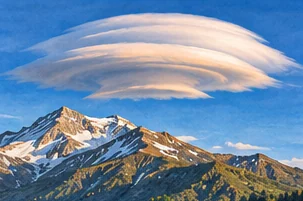
Painting: a lens-shaped cloud above a snowy summit.

Free Android app, coming soon to Google Play

Understand the world.
And remember it.

A painted scene, a question, the answer in a minute. Then the question comes back, until you know it.

We forget fast.
Unless we recall.

Each time the question comes back, forgetting slows down.

Diagram: without review, memory drops fast; with recalls on day 1, 3, 7, 14 and 30, it drops less and less. D+1D+3D+7D+14D+30 no recall with recalls
Diagram of the principle. Testing yourself and spacing reviews are the two best-rated methods in learning research (Dunlosky et al., 2013).

Memomaki in five moves

  1. 1Look

    Every day, a painted scene catches your eye.

  2. 2Think

    A real question. You think before you read.

  3. 3Understand

    The answer in a minute, with its source.

  4. 4Recall

    A few days later, the question comes back.

  5. 5Keep

    Knew it? It will come back later. If not, in ten minutes.

Some cards
are hands-on.

Drag Greenland towards the equator. Watch its size.

×its area on the map, compared with the equator

The island doesn’t shrink: the Mercator map enlarges everything far from the equator. Source

Mercator map from the North Atlantic to Africa. Greenland can be moved. Equator AfricaBrazilEurope

From the sky to the workshop,
from maps to violins.

Some series: Maps & places, Numbers & chance, Light & sight, Sound & music, Sky & time, Shape & space, Words & stories, Objects & mechanics, Art & images, Traces of the past, Kitchen mixtures, Heat in the kitchen.

Which one intrigues you?

How orchestral instruments speak

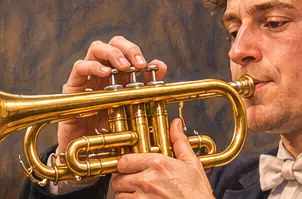
How does he play two notes without moving his fingers?

Beneath the trumpet’s three buttons, the tubing curls into loops.

Your turn

A trumpeter plays two different notes without moving a finger. How is that possible?

Show the answer

One length of tube supports several harmonics. The player can adjust the vibration of the lips to move between them.

TakeawayWatch a trumpeter’s fingers as you listen to a melody. Two notes played in succession may share exactly the same fingering.

Source: Yamaha · How does the trumpet generate sound?

Reading volcanic rock

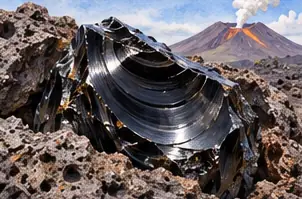
Why did this lava turn into glass?

Obsidian gleams where it breaks. Its shine and the shape of the break offer clues to how it solidified.

Your turn

Two lavas of similar composition form obsidian and a rock with visible grains. Where did crystals likely have more time to grow?

Show the answer

In the rock with visible grains, compared with the glass in the obsidian.

TakeawayVolcanic glass forms when molten rock solidifies before much of it can crystallise.

Source: BCcampus · Textures des roches magmatiques

How a limestone cave grows

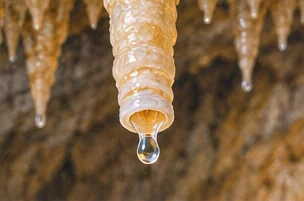
How can a stalactite be hollow?

A drop hangs from the rim of a soda straw. Calcite builds up around the channel.

Your turn

A deposit plugs the channel. What can the water form if it starts running down the outside?

Show the answer

Layers of calcite that thicken the outer wall.

TakeawayWhere water goes helps determine where the next deposit can form.

Source: National Park Service · Formations of Jewel Cave, Soda Straws

Clues to a mineral’s identity

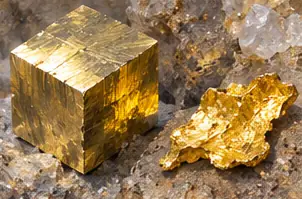
Gold or pyrite: how can you tell?

A cube and a flake both shine yellow. Their shapes offer a first clue to check.

Your turn

A yellow grain dents easily and leaves a yellow streak on unglazed porcelain. Which is more likely, pyrite or gold?

Show the answer

Gold. It deforms and leaves a yellow streak.

TakeawayCombine shape with how the specimen responds to a metal point and the colour of its streak.

Source: USGS · What Is Fool’s Gold?

Meno looks for virtue

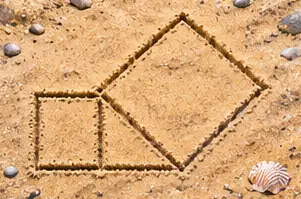
How do you double a square without calculating?

After the failed tries with 4 and 3, Socrates places four 2-foot squares side by side and draws a diagonal across each. The four diagonals form a new square, standing on its corner.

Your turn

A gardener wants a square lawn twice as large as his current square with 5 m sides. Which segment should he use as the side, without calculating anything?

Show the answer

The diagonal of the current lawn, from one corner to the opposite one. The square built on it covers 50 m², twice 25 m².

TakeawayTo double the area of a square, build the new square on its diagonal.

Source: Platon · Ménon, 84d-85d (trad. anglaise B. Jowett)

When plates move

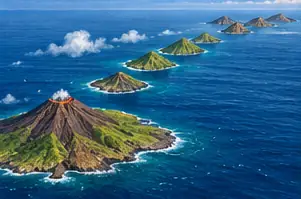
What do these lined-up islands say about the moving ground?

In Hawai‘i, the ages give a line of volcanoes a direction.

Your turn

In another chain, volcanoes get older to the east of the active volcano. Which way did the plate travel relative to the source?

Show the answer

Eastward. Older volcanoes were carried in that direction from the place where they formed.

TakeawayIn a hot-spot chain, volcanic ages show which way the plate travelled with respect to the source.

Source: U.S. Geological Survey · Geology of the Hawaiian Islands

Beneath a painting’s skin

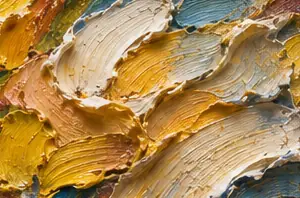
Why does this painting change as the lamp moves?

Up close, Van Gogh’s paintings show ridges of thick paint standing out from the canvas. Under a lamp placed to one side, each ridge lights up on one side and casts a small shadow on the other.

Your turn

On a printed reproduction of a heavily impasted painting, what happens when you move a lamp around it?

Show the answer

Nothing changes: the shadows are printed flat. Only the original, in relief, reacts when the light moves.

TakeawayImpasto creates real relief: its shadow moves with the light, unlike a painted shadow.

Source: National Gallery, London · Glossary, Impasto

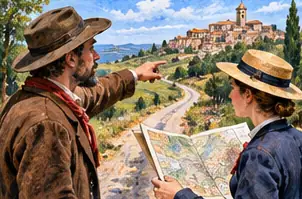
Meno looks for virtue

Whom to follow: the one who knows, or the one who guesses right?

To get to Larissa, in Thessaly, you can follow someone who knows the road or someone who guesses right without ever having travelled it. As long as the guess is right, you arrive just as surely.

Your turn

Two colleagues recommend the same supplier, one after comparing the offers, the other out of habit. Which one can still advise you if prices change?

Show the answer

The one who compared. He knows why that supplier was the best and can redo the reasoning with the new prices. The other was right without knowing why.

TakeawayKnowledge is no more correct than a true opinion, but it is more stable: you know why it is correct.

Source: Platon · Ménon, 97a-98a (trad. anglaise B. Jowett)

Coming soon to Android.

  • Free
  • No account required
  • No ads
  • No trackers
  • English and French

A confirmation link, then one single email on release, with the Google Play link. No newsletter, cancel at any time. How your address is used